Built to Last: Urban Conservation and the Future of Singapore's Built Environment
The average Singapore building lasts 33 years. But when you factor in embodied carbon and construction costs, adaptive reuse is increasingly the most rational development strategy—not just heritage preservation.
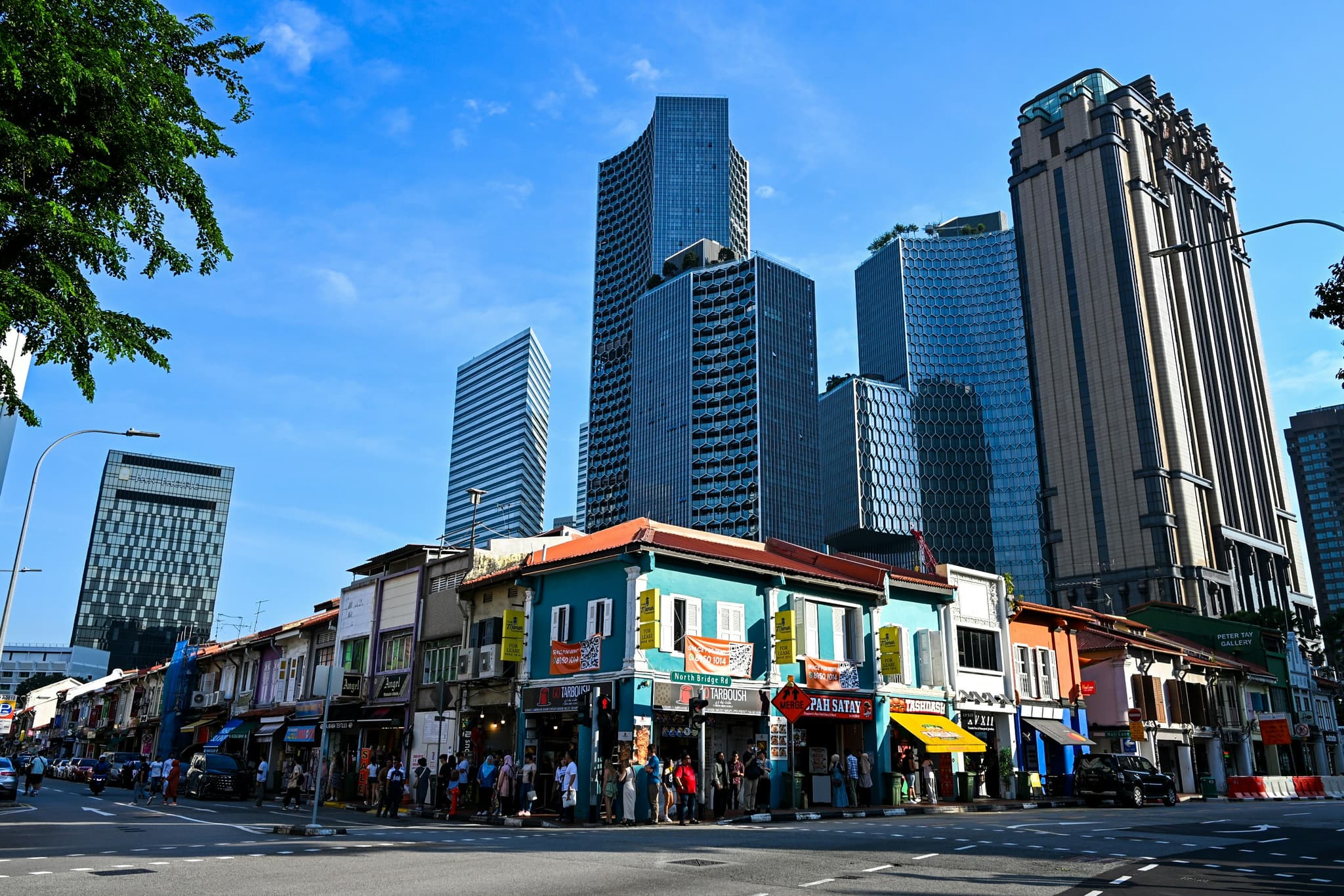
Image by Yan Zheng Xia
The average building in Singapore lasts thirty-three years. This is not because the structure fails, as most are designed for sixty to ninety years of service. It is because the economics of land in a city-state of 733 square kilometres have consistently favoured demolition and redevelopment over retention and adaptation. The default instinct, honed across decades of rapid growth, is to tear down and build new. And for much of Singapore's development history, that instinct served the nation well.
We believe that era is ending, not because of sentiment, but because the numbers have shifted. When you factor in embodied carbon obligations, construction cost escalation, placemaking premiums, and the tightening regulatory landscape, adaptive reuse is no longer a concession to heritage. It is, in a growing number of cases, the most financially and environmentally rational development strategy available. The question is why so few feasibility studies treat it that way.
The Thirty-Three-Year Habit
Singapore's relationship with its existing building stock has always been pragmatic. The urgency of nation-building, which required housing a population that grew from 1.6 million at independence to nearly six million today, demanded speed, scale, and a willingness to replace what stood in the way. That pragmatism produced one of the most liveable cities in the world. It also produced a reflex: when a building's use case changes or its lease approaches expiry, the assumption is demolition.
This reflex is reinforced by how development appraisals are structured. A conventional feasibility study compares the residual land value of a new-build scheme against acquisition cost. Adaptive reuse, by contrast, introduces variables that most pro formas are not designed to capture: the avoided cost of embodied carbon, the time-to-market advantage of working within an existing structure, the rental premiums associated with character and heritage, and the reduced risk profile of projects that do not require full demolition and reconstruction. When these variables are excluded, as they typically are, the spreadsheet will almost always favour pulling the building down.
“Retrofitting an existing building in Singapore can cut embodied emissions by nearly 70 per cent, equivalent to 4 to 6 years of the building's operational carbon.”
Research from the Singapore University of Technology and Design has quantified what practitioners have long intuited: retrofitting rather than demolishing a mid-rise building avoids roughly 2,550 tonnes of CO₂ equivalent, with a 91.8 per cent reduction in concrete-related emissions and a 63.9 per cent reduction in metals. These are not marginal savings. They represent the two most carbon-intensive material categories in construction. And in a regulatory environment where embodied carbon disclosure is moving from voluntary to mandatory, as the EU's Corporate Sustainability Reporting Directive is already in force and Singapore's own Green Plan 2030 is tightening the trajectory, the carbon case for retention will only strengthen.
The Value That Is Already Standing
Singapore protects more than 7,200 buildings under its conservation programme, of which approximately 6,500 are shophouses. These properties are, by definition, finite. No new conservation shophouse will ever be built. And the market has recognised this scarcity: one portfolio manager grew their shophouse holdings from S$400 million to S$1.4 billion in value over six years, while conservation properties consistently command a premium of around 20 per cent over comparable non-conserved assets.
But the opportunity extends well beyond gazetted shophouses. Singapore's building stock includes thousands of post-independence commercial, institutional, and industrial buildings that are structurally sound, well-located, and increasingly misaligned with their original use. The government's Central Business District Incentive and Strategic Development Incentive schemes, introduced to encourage the repositioning of ageing CBD assets, have catalysed a pipeline of refurbishment projects, including Cross Street Exchange, completed in 2025, which transformed a dated commercial building into a mixed-use lifestyle hub. These projects demonstrate that adaptive reuse is commercially viable at scale, not only for heritage-listed properties.
“Singapore's 7,200 conserved buildings are inherently finite, and no new ones will ever be built. That scarcity alone should change how we appraise them.”
In our own practice, we have seen this firsthand. Swan & Maclaren's heritage includes the design of the original Capitol Building by our predecessor architect R.A.J. Bidwell, a building that was subsequently adapted into the Capitol Kempinski Hotel, blending its original civic grandeur with a contemporary hospitality programme. Projects like this are not preservation exercises. They are development strategies that leverage existing architectural character as a competitive advantage no new-build can replicate. The patina of history, the generosity of older floor-to-ceiling heights, the solidity of pre-war construction. These are assets that the market increasingly values, particularly in the hospitality and premium commercial segments.
Why the Appraisal Needs to Change
If the carbon case is strong and the market premiums are proven, why does adaptive reuse remain systematically underweighted in development decision-making? In our experience, the answer lies in three structural biases.
The first is regulatory. Singapore's Green Mark certification, while world-leading in operational energy performance, does not yet have equivalent requirements for embodied carbon. This creates a perverse outcome: a developer who demolishes a perfectly serviceable building and replaces it with a Green Mark Platinum tower is rewarded, while a developer who retains and adapts the existing structure, saving vastly more carbon in the process, receives no comparable recognition. Until certification frameworks value the carbon already embedded in existing buildings, the regulatory incentive will continue to favour new construction.
The second is financial. Development appraisals are optimised for yield on gross floor area, and adaptive reuse projects often deliver less GFA than a clean-site redevelopment. What the pro forma misses is that the GFA delivered through adaptive reuse frequently commands higher per-square-foot rents, achieves faster lease-up, and carries lower construction risk. When the Singapore Institute of Architects and URA jointly studied conservation area performance, they found that well-executed adaptive reuse projects consistently outperformed on a risk-adjusted returns basis, but these metrics rarely appear in a standard feasibility model.
“The average Singapore building lasts 33 years despite being designed for 60 to 90. We are demolishing buildings with decades of structural life remaining.”
The third is cultural. Southeast Asia's development culture has, for understandable historical reasons, associated progress with newness. The gleaming tower signals modernity; the adapted warehouse signals compromise. This perception is changing. The success of adaptive reuse precincts globally, from London's King's Cross to Tokyo's Roppongi Hills, has demonstrated that retention and transformation can coexist with ambition. In Singapore, Gillman Barracks, the National Gallery at the former Supreme Court and City Hall, and the Warehouse Hotel in Robertson Quay have each proven that adapted buildings can anchor entire precincts. But the cultural shift needs to penetrate the feasibility table, not just the design awards.
Signals We're Watching
URA's Draft Master Plan 2025 proposes five new conservation sites and explicitly positions adaptive reuse as a placemaking strategy for major new precincts, including Pearl's Hill and Mount Pleasant. This is a meaningful signal: it suggests the planning authority increasingly views heritage retention not as a constraint on development but as a catalyst for it. We expect this integration of conservation into master planning to deepen, particularly as the government seeks to create distinctive, place-specific neighbourhoods rather than replicable new-build precincts.
Embodied carbon regulation is tightening globally, and Singapore will not be an exception for long. The Building and Construction Authority has signalled its intent to incorporate whole-life carbon assessment into future iterations of Green Mark. When that happens, and we believe it is a matter of when, not if, the economics of adaptive reuse will shift decisively. Developers who have built capability in retention and adaptation will have a structural advantage over those whose expertise is confined to new construction.
The financing landscape is also evolving. Green bonds and sustainability-linked loans increasingly recognise embodied carbon savings, and adaptive reuse projects are well-positioned to access these instruments. As ESG reporting requirements mature across the region, the ability to demonstrate avoided emissions, not just operational efficiency, will become a genuine differentiator in capital markets. For institutional investors with net-zero commitments, a well-executed adaptive reuse asset may be more attractive than a brand-new Green Mark building that required the demolition of its predecessor.
Building Forward by Looking Back
Swan & Maclaren has been practising architecture in Singapore since 1892. We have designed buildings that were later conserved, buildings that were demolished and replaced, and buildings that were adapted into something their original architects could not have imagined. That long perspective gives us a particular conviction: the most sustainable building is, more often than not, the one that already exists.
This is not an argument against new construction, as Singapore will continue to need it. It is an argument for intellectual honesty in how we appraise our options. Every development decision should begin with a genuine question: can this building have a next life? If the feasibility model is not equipped to answer that question fairly, then the model, not the building, is what needs to change.