Designing Learning Environments for the AI Era
AI is transforming how students learn. But the physical spaces where they learn remain designed for a pre-AI pedagogy. Universities need new spatial models, not better lecture halls.

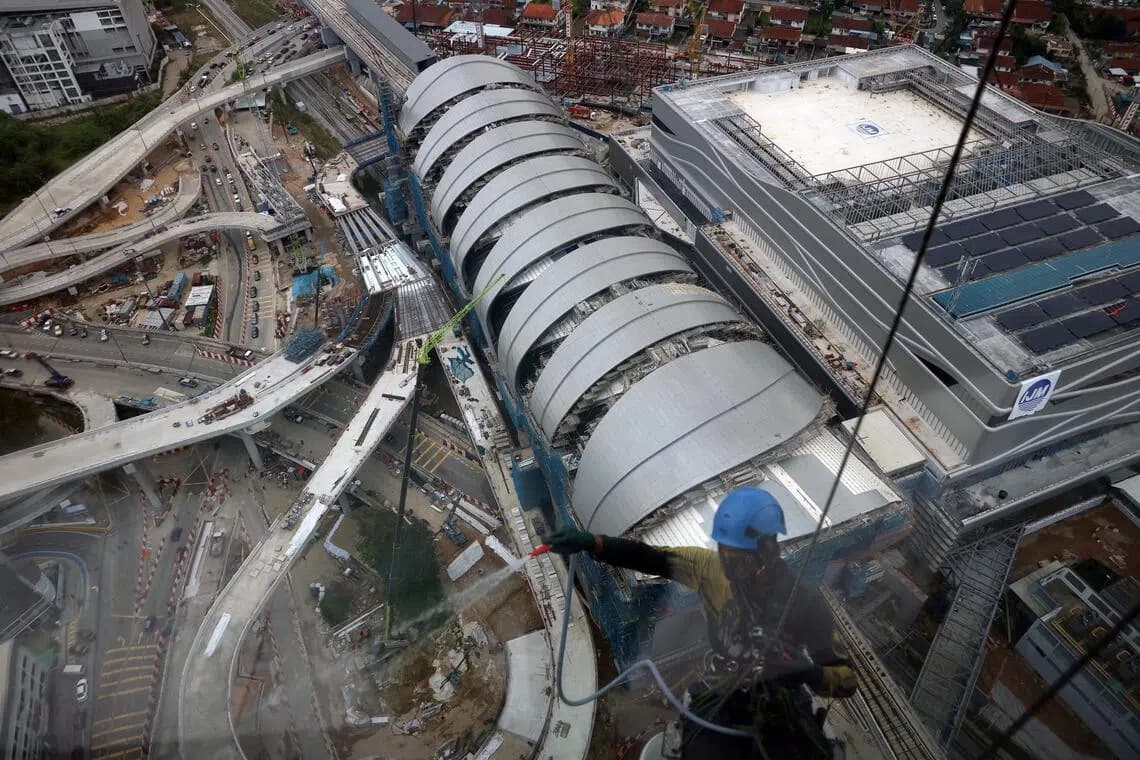
Photo by Jerry Wang
A student entering a Singapore university in 2026 has access to AI capabilities that would have been unimaginable five years ago. They can generate research summaries in seconds, produce working code from natural language descriptions, create visualisations from raw data, and receive personalised tutoring at any hour. The technology available to them has been transformed. The rooms in which they sit have not.
Across Southeast Asia, universities, polytechnics, and schools are investing heavily in new campus facilities. Singapore alone has committed to significant expansions and redevelopments at NUS, NTU, SUTD, and the polytechnics. The region's education infrastructure pipeline is substantial. But much of what is being built follows a spatial logic developed for a pre-AI pedagogy: lecture theatres for knowledge transmission, tutorial rooms for discussion, libraries for individual study, and laboratories for hands-on work. Each space type assumes a clear purpose and a predictable pattern of use.
This spatial logic is about to break. When AI can deliver knowledge, answer questions, and provide personalised instruction more effectively than a lecture hall ever could, the purpose of physical learning space shifts fundamentally. The question facing education architects today is not how to build better classrooms. It is what to build instead.
The Lecture Hall Problem
The 300-seat lecture theatre has been the anchor of university campus design for over a century. Its spatial logic is simple: one expert transmits knowledge to many students simultaneously. It is efficient, scalable, and deeply embedded in how campuses are planned, timetabled, and funded. It is also, increasingly, the wrong building for the job.
The pandemic accelerated a trend that was already underway. Students discovered that recorded lectures, accessible on demand and at variable speed, were in many cases more effective than live delivery. Attendance at physical lectures has not recovered to pre-pandemic levels at most institutions in the region. AI is accelerating this further. When a student can ask an AI tutor to explain a concept in multiple ways, at their own pace, with infinite patience, the value proposition of sitting in a tiered auditorium listening to a one-size-fits-all lecture diminishes further.
“When AI can deliver knowledge more effectively than a lecture hall, the purpose of physical learning space must be redefined entirely.”
This does not mean the lecture theatre disappears overnight. There are pedagogical contexts, such as the inspirational keynote, the Socratic demonstration, and the guest practitioner, where large-format live instruction remains powerful. But as the primary vehicle for knowledge delivery, the lecture theatre is being superseded. And yet, campus master plans continue to allocate significant floor area and construction budget to this typology, because it is what the institution knows how to programme, timetable, and justify to its funding body.
The risk is not that universities build lecture theatres they do not need today. It is that they build lecture theatres that will be obsolete in fifteen years but will stand for fifty. A building completed in 2028 will need to serve students in 2060. The pedagogical assumptions embedded in its floor plates, its structural grids, and its servicing strategy will either accommodate the learning models of that future or constrain them.
Designing for What AI Cannot Do
If AI increasingly handles knowledge transmission, the physical campus must focus on what AI cannot replicate: collaboration, making, mentorship, serendipity, and the embodied experience of working with materials, spaces, and other human beings. This is not a speculative claim. It is already visible in the most progressive campus designs being realised today.
From 2026, SUTD is embedding AI across all three terms of its first-year curriculum, which means its physical spaces are now being tested against a genuinely AI-integrated pedagogy. The early evidence is instructive: the spaces that work best are not the most technologically equipped, but the most spatially flexible. Studios and maker labs that can be reconfigured for different team sizes, different project types, and different modes of working within a single semester.
“The most effective learning spaces in an AI era are not the most technologically equipped. They are the most spatially flexible.”
Maker spaces, fabrication labs, and design studios share a common characteristic: they are spaces where students work with their hands, build physical prototypes, test ideas in three dimensions, and learn through failure in ways that no screen-based interaction can replicate. These are the spaces that AI amplifies rather than replaces. An engineering student who uses AI to optimise a structural design still needs a workshop to build and test the physical model. A medical student who uses AI to study anatomy still needs a simulation suite to practise clinical skills. An architecture student who uses AI to generate design options still needs a studio to develop, critique, and refine them with peers and mentors.
The spatial implication is significant. Campus plans that allocate the majority of their floor area to passive learning spaces, including lecture theatres and tutorial rooms where students sit and receive, need to be rebalanced toward active learning spaces where students make, collaborate, and create. This is not a marginal adjustment. It implies a fundamentally different ratio of space types, different servicing requirements, different structural grids, and different relationships between indoor and outdoor learning environments.
The Adaptability Imperative
The deepest challenge in education design today is not choosing the right spatial model. It is acknowledging that no one yet knows what the right spatial model will be in twenty years, and designing buildings that can accommodate that uncertainty.
AI is evolving so rapidly that any campus designed around a fixed assumption of how AI-augmented learning will work is likely to be wrong. The pedagogy of 2035, let alone 2050, is genuinely unpredictable. This argues powerfully for buildings designed with maximum adaptability: generous floor-to-floor heights that accommodate future servicing requirements, structural grids that allow spaces to be subdivided or combined without major intervention, flat floor plates rather than tiered lecture halls, and servicing strategies that anticipate increased power and data density without requiring disruptive retrofits.
“A campus building completed in 2028 will need to serve learners in 2060. The pedagogical assumptions built into its structure will either enable that future or constrain it.”
NTU's Campus Vibrancy Master Plan offers a useful reference point. Rather than committing to a single vision of how learning spaces should function, it is reimagining the campus as an adaptive ecosystem where living, learning, working, and social spaces blend and evolve over time. This is the right instinct: designing the campus as a platform for change rather than a fixed expression of today's best guess.
Swan & Maclaren advocates for what it calls pedagogical resilience in education design: the ability of a building to support teaching and learning methods that have not yet been invented. This is not about building generic spaces with no character. It is about making intelligent structural and servicing decisions that keep options open, while designing the immediate fit-out and furniture systems for rapid reconfiguration. The structure should last sixty years. The spatial configuration should be changeable every five.
Signals to watch
Singapore's six autonomous universities and five polytechnics are all reviewing their physical estate strategies in light of AI-driven pedagogical change. NUS's net-zero building cluster at Kent Ridge, which integrates the School of Design and Environment with new interdisciplinary research facilities, signals a direction: buildings designed around cross-disciplinary collaboration rather than departmental boundaries. More institutions are expected to move toward this model as AI renders discipline-specific knowledge more accessible and the premium on interdisciplinary thinking increases.
The polytechnic sector, which trains the majority of Singapore's technical workforce, faces perhaps the most acute version of this challenge. AI will automate significant portions of the technical skills that polytechnic programmes currently teach, including drafting, basic coding, routine analysis, and standard calculations. The polytechnics that respond by redesigning their physical environments around applied problem-solving, prototyping, and industry collaboration will produce graduates who complement AI rather than compete with it. Those that continue to build conventional classroom blocks will be training students for jobs that are already changing.
Across the region, there is a growing gap between institutional ambition and spatial reality. Universities from Vietnam to Indonesia are investing in AI curricula, industry partnerships, and research programmes, but many are housing these ambitions in buildings designed for a fundamentally different mode of learning. The institutions that align their physical infrastructure with their pedagogical ambitions, rather than retrofitting one into the other, will have a lasting advantage in attracting students, faculty, and research funding.
Buildings That Learn
The irony of education architecture is that the buildings themselves rarely learn. They are designed for a specific pedagogical model, built to that model, and then expected to perform for decades as the model evolves around them. AI is accelerating the pace of that evolution to a point where this rigidity is no longer sustainable.
The learning environments that will serve the next generation well are not the ones with the most advanced technology embedded in their walls. They are the ones designed with enough intelligence in their structure, their servicing, and their spatial organisation to accommodate uses their architects could not have predicted. In an era where what we learn is changing faster than it ever has, the buildings we learn in must be designed not for certainty, but for change.