From Protected Assets to Climate Resilient Infrastructure
Singapore's climate adaptation conversation has been dominated by big infrastructure numbers. But true resilience comes from designing buildings that actively participate in their cities' climate response.
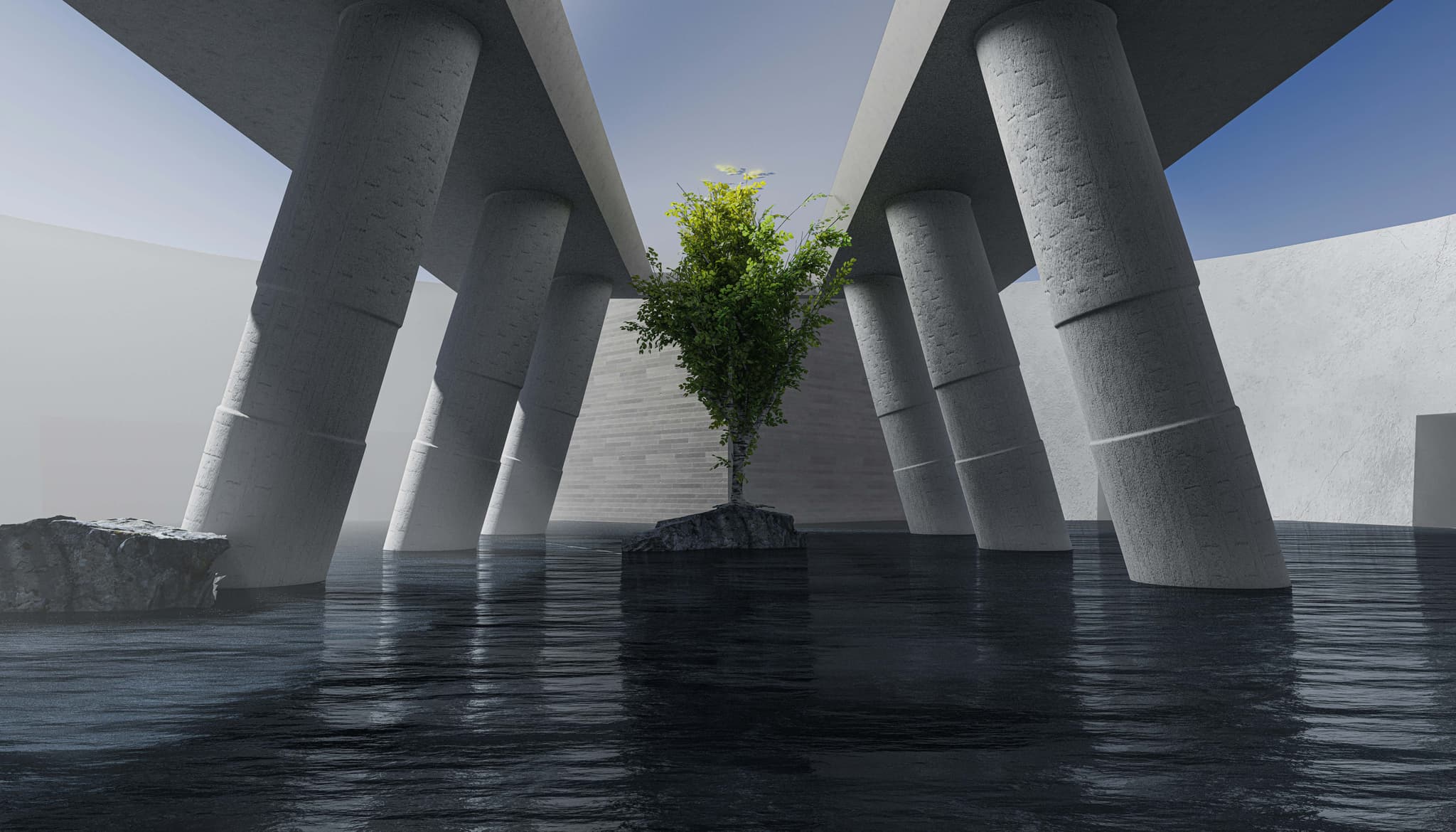
Image by Sumaid pal Singh Bakshi
Singapore's climate adaptation conversation has, by necessity, been dominated by the big numbers. A hundred billion dollars committed to coastal protection. Sea levels projected to rise by up to a metre by 2100. A national flood management programme that has widened and deepened over 100 kilometres of drains and canals. These are serious commitments to a serious problem, and they deserve the attention they receive.
But we believe the conversation is incomplete. The dominant framing treats the built environment as something to be defended, a collection of assets sitting behind seawalls, waiting to be shielded from rising waters and intensifying heat. In our experience designing and engineering buildings across Southeast Asia, this is a missed opportunity. The more productive question is not how do we protect buildings from climate, but how do we design buildings that actively participate in the resilience of the cities they inhabit?
This is not an abstract distinction. It is the difference between a building that merely survives its environment and one that makes its neighbourhood measurably cooler, drier, and more adaptive. The technology, the regulatory frameworks, and the design methodologies already exist. What is missing is an integrated way of thinking about them, and the will to move beyond compliance toward genuine contribution.
The Protection Paradigm and Its Limits
Singapore's approach to climate resilience has been, by most measures, exemplary. The government's coastal protection strategy is comprehensive, with site-specific studies completed for the City-East Coast corridor in 2025 and a new Code of Practice for Coastal Protection expected from PUB by 2026. The Long Island reclamation project, which spans 800 hectares of new land off the East Coast, will integrate flood protection, a new reservoir, and future development in a single infrastructure move. These are not half-measures.
“Singapore has committed S$100 billion to coastal protection over the next 50 to 100 years, but protection alone does not equal resilience.”
And yet, the overwhelming emphasis remains on protection: seawalls, tidal gates, raised platform levels, and expanded drainage capacity. PUB's Source-Pathway-Receptor framework, adopted in 2012, was a genuine advance. It introduced the idea that stormwater management begins at the source, not just the drain. Since 2014, all new developments above 0.2 hectares have been required to implement on-site detention measures. But in practice, most developers treat this as a compliance exercise: install a detention tank, satisfy the requirement, move on.
We see a similar pattern with BCA's Green Mark 2021 framework, which commendably introduced resilience as a formal assessment category. Projects must now conduct climate change risk assessments, develop adaptation action plans, and identify strategies for urban heat island mitigation. The intent is right. But when resilience is one checkbox among many in a certification scheme, it tends to produce compliant buildings rather than contributory ones. The question we keep returning to in our own practice is: what if the building itself were part of the infrastructure?
Buildings as Resilience Infrastructure
The conceptual shift we are advocating is straightforward, even if its execution is not. Instead of asking how a building can be made resilient to its climate context, we should be asking how a building can improve the resilience of its precinct. This requires thinking across three dimensions simultaneously: thermal performance at the urban scale, water management as a distributed system, and structural adaptability over a building's full lifecycle.
Consider heat. Singapore recorded its highest temperature in forty years, 37°C in Ang Mo Kio, in 2023, and researchers estimate the city endured 122 additional days of dangerous heat in 2024 attributable to climate change. The urban heat island effect in Singapore's densest corridors can push local temperatures 4 to 7°C above surrounding areas. The standard response has been to mandate cool materials and greenery on individual buildings. But the research consistently shows that meaningful cooling happens at the precinct level, not the building level. Wind corridor design in Jurong Lake District, for instance, uses prevailing northeast and south wind flows to ventilate entire urban blocks. Thermal analysis at Paya Lebar Quarter demonstrates that well-designed landscape planting can lower temperatures by 8 to 9°C in unshaded areas, but only when the planting is coordinated across the precinct, not confined to individual building plots.
“Well-designed precinct-level planting at Paya Lebar Quarter reduced local temperatures by 8–9°C, a result no single building could achieve alone.”
Water tells a similar story. Singapore's ABC Waters programme, launched in 2006, pioneered the integration of drainage infrastructure with public green spaces, including bioretention basins, rain gardens, and constructed wetlands that treat stormwater as a resource rather than a nuisance. The programme was visionary, but its implementation has remained largely in the public realm. The opportunity we see is to extend this logic into building design itself: roof systems that harvest, filter, and slowly release rainwater; podium landscapes that function as bioretention infrastructure; basement designs that provide flood storage capacity for their surrounding streets. Tengah, Singapore's newest eco-town, hints at this integration with its central park designed to regulate stormwater across the entire precinct, but we believe the principles can be applied far more aggressively in private-sector development.
Then there is adaptability, the least discussed but arguably most important dimension. A building designed in 2026 will need to perform in the climate of 2070. That means designing for conditions we have not yet experienced: more intense rainfall events, longer heat waves, and possibly regulatory requirements that do not yet exist. In our engineering practice, we increasingly advocate for structural systems that can accommodate future retrofits, such as raised floor-to-floor heights that allow mechanical system upgrades, façade systems designed for eventual replacement, and MEP infrastructure with built-in redundancy. This is not over-engineering. It is designing honestly for uncertainty.
Why Integration Is the Hard Part
None of the individual strategies above are new. Cool materials, green roofs, rain gardens, adaptive structural design. All of these are well-understood and widely documented. The reason they have not yet transformed the built environment is not technical. It is organisational.
The typical development process in Southeast Asia separates architecture from engineering from landscape from sustainability consulting. Each discipline optimises within its own scope. The architect designs for programme and aesthetics. The structural engineer designs for loads and codes. The MEP engineer designs for system performance. The sustainability consultant designs for certification. The result is a building that satisfies every individual brief but misses the systemic opportunity, because no one was tasked with thinking about how the building relates to its precinct's thermal envelope, or how its drainage connects to the neighbourhood's water management, or how its structural choices enable or foreclose adaptation thirty years from now.
“Buildings account for approximately one-third of energy consumption and emissions in Southeast Asia, and the region's building floor space is projected to double by 2060.”
This is where integrated AEC practice becomes not just a commercial preference but a climate imperative. When architecture, structural engineering, MEP design, and landscape are coordinated from the earliest concept stage, as they should be on any project that takes resilience seriously, the building can be designed as a system rather than an assembly of independently optimised parts. The wind corridor considerations that shape the massing also inform the natural ventilation strategy. The stormwater management that determines the landscape also shapes the structural design of the podium. The façade performance that drives the energy model also influences the long-term maintenance and adaptation plan.
We recognise that this is easier to articulate than to execute. It requires different contractual structures, earlier collaboration between disciplines, and clients who understand that resilience is not a line item to be value-engineered out. But the projects that get this right, and we are beginning to see them in Singapore, in Jurong Lake District, in Tengah, and in scattered private-sector developments, demonstrate that the performance gap between compliant buildings and contributory buildings is significant and widening.
Signals to watch
Singapore's draft Master Plan is increasingly explicit about precinct-level climate performance, with URA and NUS collaborating on Doppler Wind LiDAR studies in Jurong Lake District to build empirical wind data into planning guidelines. If this approach scales, and we believe it will, future developments may be assessed not just on their own environmental performance but on their contribution to the climate performance of their surroundings. This would be a fundamental shift in how we evaluate the built environment, and one that integrated design practices are better positioned to respond to.
The insurance and finance sectors are beginning to price climate risk into real estate valuations across the region. As physical risk modelling matures, buildings that merely comply with minimum resilience standards will face higher capital costs than those that demonstrate genuine adaptive capacity. We expect this pricing signal to sharpen considerably over the next five years, particularly for commercial and institutional assets in flood-exposed zones. For developers, the business case for going beyond compliance is no longer hypothetical.
Across Southeast Asia, the conversation is shifting from national-level adaptation to building-level performance. The World Green Building Council's 2025 Asia Pacific report shows green-certified buildings consistently outperforming conventional assets on both financial returns and operational resilience. But the next frontier is not green certification. It is resilience certification, and the frameworks for it are still being written. The firms and developers who shape those frameworks, rather than simply responding to them, will define how Southeast Asia builds for the next half-century.
The Question Worth Asking
Singapore has proven, repeatedly, that it can engineer its way through existential challenges, from water scarcity to land constraints to public housing at scale. Climate adaptation will be no different in ambition, but it demands a different kind of thinking. The infrastructure-first approach that has served the nation well is necessary but insufficient. The next layer of resilience will come not from bigger seawalls but from smarter buildings, buildings that cool their streets, manage their water, and adapt over time.
For every project that crosses our desks, we now ask a simple question: does this building make its neighbourhood more resilient, or merely more resistant? The distinction matters more with every degree of warming and every millimetre of sea level rise. And the answer, increasingly, depends not on any single discipline but on whether the disciplines were integrated from the start.