A Transit-Oriented Development: Designing the SG > JB Causeway into a City
Singapore and Johor have built a remarkable connection. The opportunity now is to shape a shared region.
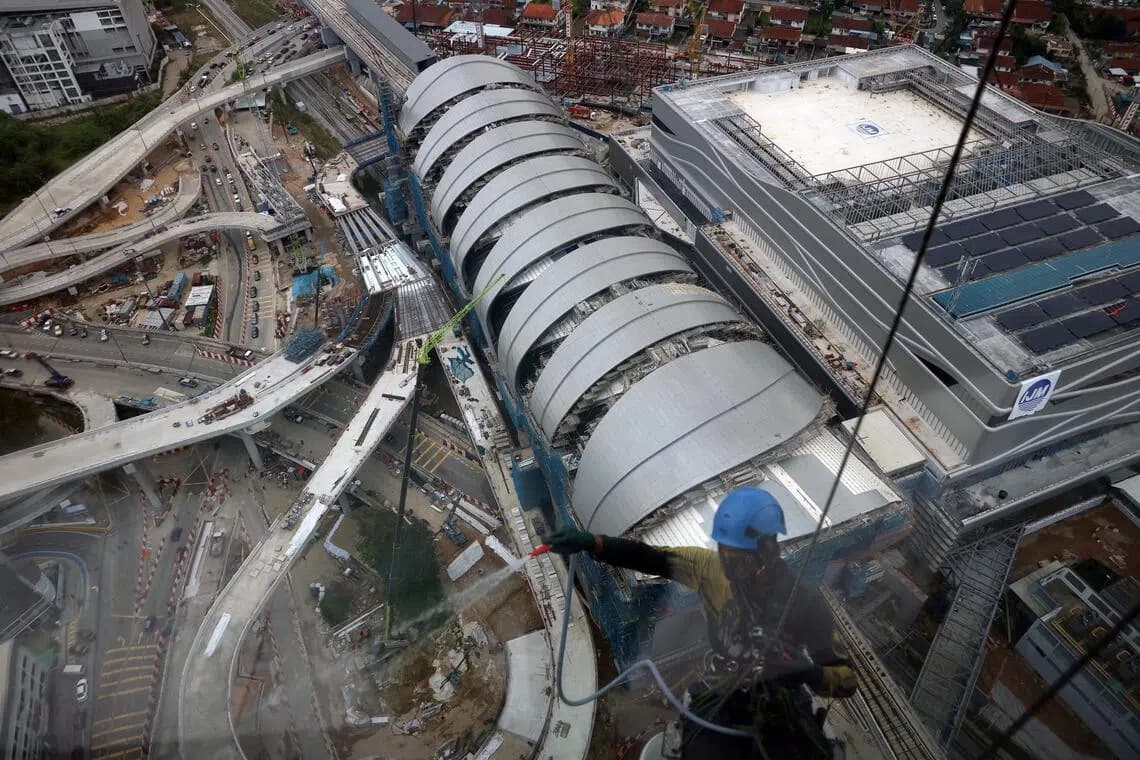
In a little over a year, a train will begin crossing the Straits of Johor every few minutes, carrying up to ten thousand people an hour in each direction on a four-kilometre line between Bukit Chagar and Woodlands North. It will lift more than a third of peak-hour traffic off a causeway that has slowed to a crawl twice a day for a generation. Alongside it, the Johor-Singapore Special Economic Zone is drawing a hundred projects and twenty thousand skilled jobs in its first five years, supported by a five per cent corporate tax rate and a land area almost five times the size of Singapore. This is one of the most promising urban moments the region has seen in a generation.
The ride time and the tax rate have rightly captured the headlines, and they are what make everything else possible. The prospect we find most compelling, as architects and engineers who work at this scale, lies a step beyond them: in what takes shape in the first five hundred metres around each station, and in the character of the corridor that joins them. Singapore and Johor have built a superb connection. The opportunity now is to design a region around it, and it is a rare one.
Connection Is the Foundation
The experience of other cross-border regions is encouraging, and it points to where the lasting value lies. Where these regions have flourished, it has been because connection was paired with a shared sense of place. The Shenzhen and Hong Kong metropolis, now the anchor of the Greater Bay Area, grew into one of the world’s great urban regions when governments chose to design the seam between the two systems as a shared project rather than simply to link them. Connection set the stage; design made the region. San Diego and Tijuana, joined for half a century, remind us gently of how much that shared design unlocks, having remained close neighbours more than a single place. The heartening reading is that the Singapore-Johor region already holds the harder half, the connection itself, firmly in hand.
There is a pleasing symmetry worth noting. The operator most associated with Hong Kong’s success, MTR Corporation, is already part of the story on the ground here, and it brings a deep understanding of how rail and place can be designed together. The ingredients that made other regions thrive are, encouragingly, already present in this one.
“While connection sets the stage, shared design is what turns two cities into one region.”
A rail link and a special economic zone are powerful instruments. They lower the friction of movement and the cost of capital, and they are already doing so with real momentum. What they invite is a shared idea of the place that will grow around the points where all this movement gathers. That is a question of urban design, and we think it is the most rewarding one now on the table.
The Value in the Whole
The momentum on the ground is striking. Iskandar Malaysia has already attracted well over RM400 billion in cumulative investment, and the special economic zone spans some 3,288 square kilometres across nine flagship areas and eleven priority sectors, each with its own ambitions, agencies and champions. The compelling question is how to make the whole worth even more than the sum of these considerable parts.
“When a hundred projects are designed to add up to one place, the region becomes worth far more than the sum of its parts.”
This is where a shared design vision earns its keep. When many strong projects are shaped with the whole region in mind, they begin to lift one another: a residential precinct on one side supports a business district on the other, a park meets a promenade across the water, and each investment raises the value of the next. The region already has an impressive machinery for attracting and coordinating capital. The natural next step is to give that machinery a shared picture of the physical region it is helping to build, so that form keeps pace with finance. It is a role waiting to be embraced, and one that would give investors and communities alike even greater confidence in what they are joining.
Designing the Space Between
If the ambition is a single region, we would offer three ideas for how design can help bring it to life.
The first begins with something both sides are already doing very well. Bukit Chagar is rising as a lively mixed-use transit-oriented development on the Johor terminus, a RM2.6 billion undertaking, with Hong Kong’s MTR Corporation, author of the global playbook on designing around stations, part of the effort. Across the water, JTC’s Woodlands North Coast is taking shape as its Singapore counterpart, a district of homes, offices, parks and retail gathered around the crossing. These are two of the most thoughtfully conceived transit-oriented developments in the region.
The opportunity we find most compelling is to let these two strong developments look towards each other, and not only inward. Transit-oriented design has traditionally been a discipline of the single station and its immediate catchment. Here there is a chance to extend that same care to the corridor as a whole, to the four kilometres of water and the two urban edges between the catchments, designing the whole corridor as one transit-oriented region.
“Two strong transit-oriented developments, designed to face one another, can become a single transit-oriented region.”
In practice this means holding the ground between Bukit Chagar and Woodlands North to the same standard of design as the stations themselves, and doing so now, while land is still being assembled and the choices remain wide open. The moment when the form of a place can be shaped most freely comes early, and this is that moment.
A second idea is a shared sense of experience across the border, a common intention for how the public realm feels, so that crossing the strait feels like moving through one region rather than switching between two systems. This is not about making the two sides the same; the contrast between them is part of the region’s character. It is about a shared generosity in the things people feel underfoot: legibility, walkability, the quality of the ground plane, and the ease with which the two rail networks welcome a traveller from one to the other. Integration is felt on the pavement long before it appears in a trade statistic, and it is one of the most rewarding things good design can offer.
A third is to bring design forward, so that it travels alongside the infrastructure rather than following behind it. The RTS Link is well advanced, and the coming waves of investment, the feeder networks, the next rail decisions and the release of new precincts, are a real chance to let a shared design vision shape those choices early, when it can add the most value. This is the work an integrated practice most values: holding architecture, engineering, landscape and planning in a single conversation at the scale of a whole region, and helping partners see how the pieces can come together into a place greater than any of them alone.
Signals We’re Watching
We are watching, with real optimism, for the moment when the region’s shared work broadens from attracting investment to shaping shared space, and the physical form of the region is taken up as a common project. It would be a defining sign that the region intends to become a city in full, and there is every indication the appetite is there.
We are watching, too, how placemaking keeps pace with the enthusiasm of the market. Land around Bukit Chagar is already appreciating on the strength of the connection, a healthy vote of confidence. The opportunity is to match that confidence with an equally ambitious vision for the quality of place, so that what gets built lives up to what is being priced in.
And we are following the quieter, second-order infrastructure that so often decides how a place feels to live in: the feeder buses, footpaths and cycle networks, the fine grain of local connection that turns stations into neighbourhoods. Strengthening these last links, especially on the Johor side, is less visible than a landmark crossing, yet it does just as much to shape daily life, and there is real room to lead here.
The Region We Could Build
The causeway has been a line on the map for a century. The infrastructure now nearing completion offers the chance to make it something richer: the heart of a shared region rather than simply a faster way across. That transformation is well within reach, and much of the hardest part, the connection itself, is already done.
For every regional project that reaches our desks, we have begun to ask ourselves a simple and hopeful question alongside the usual ones about cost and yield. Not only how quickly people can cross this border, but what they will arrive into when they do, and how much possibility that place can hold. The next few years are a chance to answer it well, and to help the causeway become the centre of something new.